Long-context inference carries a quiet tax: teams keep paying to prefill work their fleet has already done. RAG apps retrieve the same documents. Agents revisit the same plans, tool outputs, and state summaries. The prompt changes, the chat template changes, the section order changes, but the expensive context stays familiar.
Exact prefix caching only reuses that work when the new request starts with the same bytes. Production traffic is rarely that clean, so the GPU recomputes everything from scratch. This two-minute overview shows how Synapse recovers the reuse hiding behind different prompt framing.
What it walks through:
- Prefix cache misses. The same contract or document shows up under a chat wrapper, a RAG template, and a reordered instruction. Exact caching sees three different byte streams and misses all three.
- A semantic context layer, not a response cache. Synapse is a semantic KV fleet router. It sits in front of your worker pool and decides where each request should run.
- Semantic fleet routing. The router matches semantic fingerprints and sends each request toward the worker most likely to hold compatible donor KV.
- Reuse spans, recompute holes. At the worker, the backend stitches donor KV spans with new ones and recomputes only the fresh holes. Less prefill, faster first token.
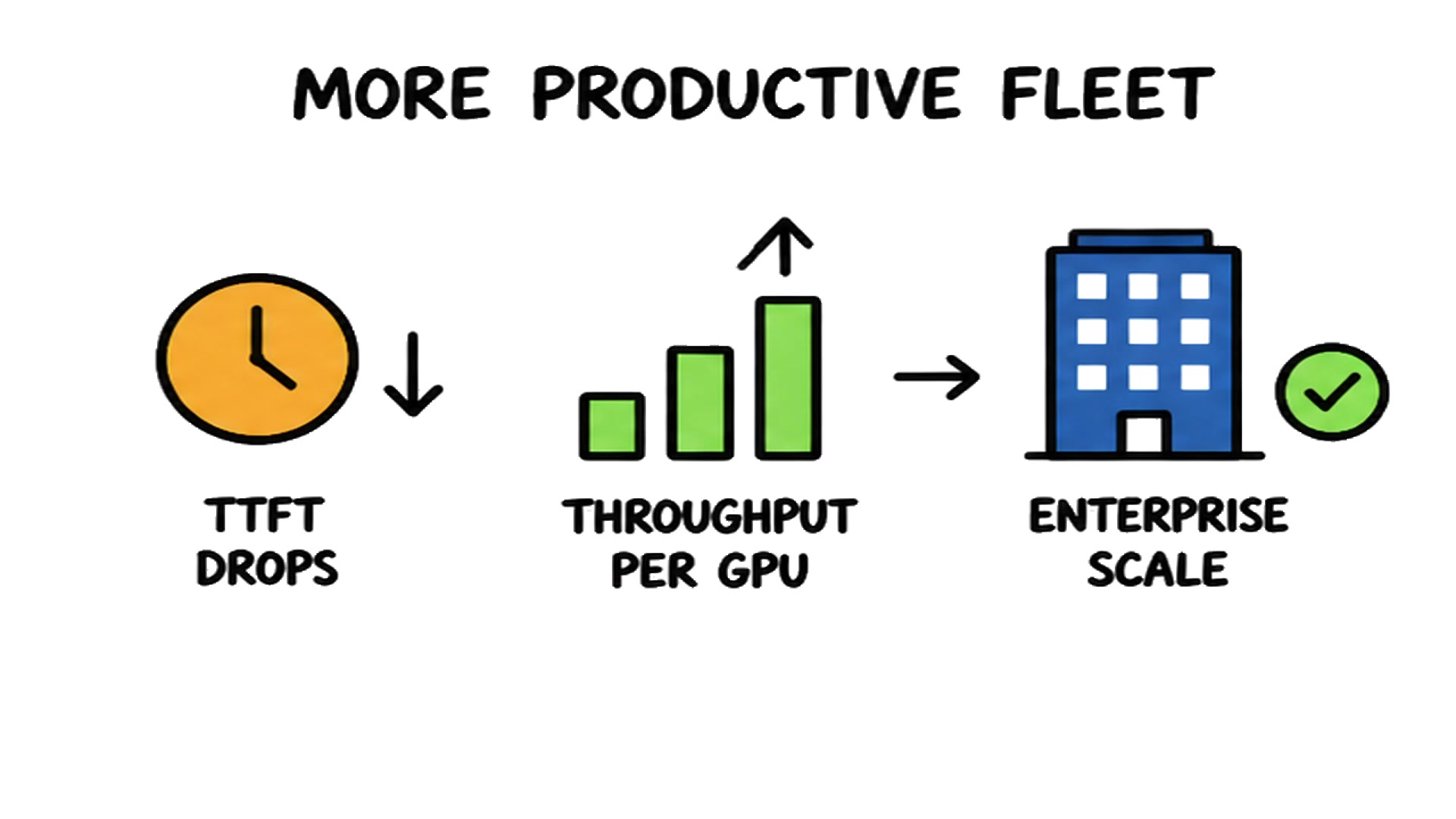
- A more productive fleet. Time to first token drops, useful throughput per GPU rises, and long-context enterprise workloads become practical to serve at scale.
Synapse turns missed reuse into real capacity, without changing the model and without caching responses.
For the engineering detail behind the routing layer, read Synapse: Routing Long-Context AI Toward Reusable Compute.